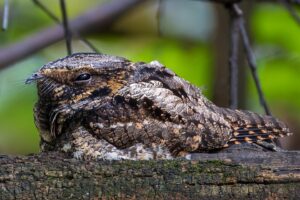
The evening song of the whippoorwill had a quality that provided me both mystery and an emotive resonance. As a boy, this lovely three-note serenade was a symphony marking the transition from a day of adventurous play to an evening of blissful sleep. This song was as reliable as the setting sun. Their calls were enigmatically voiced from — where? I never knew. The melody simply arose from somewhere in the surrounding woodlands. It filled the air with not only loveliness but a message of comforting constancy.
Once, camping in neighboring Greene County with my brother, we were honored with the competing choruses of three or four whippoorwills, each determined to surpass the others in loveliness and endurance. We tucked into our sleeping bags and, through gaps in the tree crowns, admired the rich, starry sky. Well into darkness, as drowsiness assaulted us, the songs continued. I did not comprehend that I was storing a memory which would someday bring me tearful recollections.
I describe the song of the whippoorwill in the past tense. Many years have passed since I have been graced by its elegant evening aria. Once, a few years ago, the bird’s cousin, a chuck-will’s-widow, sang beautifully and hopefully near our rural home. It did so for a single night and has been heard no more.
Both of these nightjar species have joined a long list of animals whose populations have declined precipitously during my lifetime. You have likely noticed this trend in the preceding stories I have shared. African and Asian elephants, sharks, pangolins, and sea turtles — all are far less abundant than they once were. In 1973, I first stepped into the wondrously diverse rainforest of Southeast Asia. Since that time, monitored populations of wildlife on our planet have decreased by seventy-three percent (https://www.zsl.org/what-we-do/projects/living-planet-index).
What variable in the complex ecological equation of Earth’s biodiversity is central to such a devastating loss? When I graduated from high school in 1964, the global population of humans was a little over three billion. Now, nearing my eightieth year of life, it is estimated at somewhat over eight billion. We surely cannot ignore the impact on the natural world of this massive increase in our own population. A human population two-and-a-half times larger than it was six decades ago has driven increased habitat loss, wildlife exploitation, environmental pollution, and resource depletion.
The land we commandeer harbors creatures that have evolutionary histories eons older than our own. These organisms represent the crown jewels of the Creation. Their long adaptive journey on Earth has produced beauty as well as the most intricate ecological interrelationships imaginable. Many would argue that their lengthy geologic voyage has also earned them a right to exist. In the human drive to dominate our planetary home, these facts seem to be tragically irrelevant. And so it is that I grieve.
But historically, I must remind myself, human actions have provided us with gossamer fibers of hope. As a boy, even a young adult, dreams of seeing a bald eagle near my southwestern Indiana home were just that — so much wishful thinking. Essentially gone from my state by the 1900s, our national bird was devastated nationwide by the scourge of the pesticide DDT. This chemical 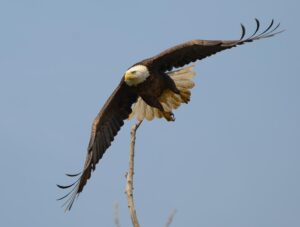 bioaccumulated within the eagle’s prey. The birds laid eggs with weakened shells which cracked under the weight of the incubating adult. The U.S. ban on DDT in 1972, coupled with passage of the Endangered Species Act in 1973, has led to a population resurgence. Indiana now has three hundred and fifty nesting pairs. At the venerable age of sixty-five, I finally saw bald eagles near my home.
Likewise, I was in late adulthood when I first heard the bugling of sandhill cranes above my rural Sullivan County homestead. It was a sound that has enchanted me over many years. Their calls seemed to me to be the voices of wildness incarnate. Tracing the trumpeting path of their descent, I found myself mesmerized by the sight of hundreds of sandhill cranes parachuting from the gray, springtime sky onto a marshland not two miles away. In the 1930s, a survey found only about two dozen pairs of these magnificent birds in Wisconsin, a major nesting area for the eastern population. Today this population is nearly one hundred thousand strong. Protection from unregulated hunting and the North American Wetlands Conservation Act accomplished much.
Even within the ocean depths, we can find stories that hint that not all is lost. Humpback whales, like many of their kind, had their populations decimated by global commercial whaling. The number of humpbacks in the Western South Atlantic was reduced from twenty-five thousand to fewer than five hundred individuals. The worldwide moratorium on commercial whaling (1986) has resulted in global populations of this wondrous species regaining over ninety percent of its historic size. Such success stories give us hope. We see concrete evidence that, given intent and dedication, humans can restore what we have tarnished.
Whether through some unfathomable grace, an abundance of good fortune, or a fated destiny, it has been my privilege to encounter some of the world’s beautiful ecosystems and their inhabitants. The dynamic soaring of a waved albatross, the wild song of the sandhill crane, the booming voice of the siamang, the tropical rainforest — Earth’s greatest expression of its extraordinary biodiversity — encountering these wondrous experiences has given my life meaning and a feeling of deep gratitude.
Yes, the conservation success stories are many — American alligator, California condor, gray whale, peregrine falcon, black-footed ferret, saiga antelope, southern white rhinoceros — all elicit a sigh of relief as we contemplate their close encounter with extinction. But sadly, such stories can lull us into a false sense of accomplishment in battling Earth’s extinction crisis. We don’t have to look far to find accounts that crush our hopes.
A 2025 study appearing in the journal Nature Reviews Biodiversity considered the endangered species listed on the International Union for Conservation of Nature’s so-called Red List. Globally, over ten thousand critically endangered species were recognized. Sixty percent of these were plants.

Fifteen percent of the endangered species had populations fewer than fifty individuals. A few, like the vaquita, the world’s smallest cetacean, have a greater than fifty percent chance of becoming extinct within the next decade.
Accelerated global biodiversity loss is serious enough to have caused many scientists to suggest that we are amid Earth’s sixth mass extinction episode. I find this an incredibly sobering thought — perhaps heartbreaking is a better term. I have difficulty coming to grips with this disaster of disasters that, for the most part, has occurred during my own lifetime. The loss of biodiversity seems too rapid, too insidiously global for me to fully comprehend. How is this possible? The only place in the universe that verifiably harbors complex life is our own planetary home. How can we so thoughtlessly, and with such persistence, decimate the irreplaceable wonder represented by Earth’s diverse ecosystems and their flora and fauna? A vile stew of human overpopulation, ignorance, poverty, and greed has landed us in this biodiversity crisis.
I try to maintain hope that the human species will awaken before all is lost. But, as I do so, I suddenly find another thought occurring to me. We humans have been here, in our modern form, for about 0.006 of a percent of Earth’s total history. Trilobites, brachiopods, and primitive fishes dominated Earth for 300,000,000 years without us. The dinosaurs and marine reptiles were equally successful, in our absence, for 180,000,000 years. Mammals and birds in their multitudinous forms did quite well without us for 65,000,000 years.
Here is another way to appreciate the place of humans in the proliferation of life on Earth. Let’s condense the four and a half billion-year history of our planet into a calendar year. On such a scale, the first vertebrates appear in late November. The first trees come into existence around the first of December. Dinosaurs and mammals emerge in mid-December, and the first birds later in that month. Modern humans capable of practicing agriculture and industrial technology do not show up until two minutes before midnight on December 31st.
Considering such facts, I can only conclude that neither the Earth, nor the other living things with which we share it, really need us. Human hubris may cause us to believe otherwise, but — and as a Homo sapiens it pains me to admit this — geologic history should tell us this is fantasy. Despite this sobering realization, I cannot help but feel tremendous anguish as I witness the damage our species has inflicted upon a world so staggering in biological beauty and complexity. Will our great-grandchildren have the chance to thrill at the sight of a wild African elephant, the resonant, complex whooping of a white-handed gibbon, or the magnificence of a coast redwood nine times older than our nation?
Our planet’s richness of life has been evolving for periods of time beyond our ability to fully comprehend. Earth’s fossil record tells us that mass extinctions are real. But this evidence also tells us of the incredible ability of biological life to survive in some form, and rebuild a world of new appearance, new tactics for survival, and, as Darwin described them, endless forms most beautiful and most wonderful.
We should feel neither shame nor regret in mourning the loss of the plants, animals, and wild places we have known from childhood. These are the spaces and living things we have loved and have contemplated with awe. But we might also recall a lesson from one of Earth’s most dire extinction events. Two hundred and fifty million years ago, ninety percent of all life on Earth was wiped out during the cataclysmic Permian-Triassic extinction. From the biological wreckage of that global catastrophe arose all the new lineages of life we see around us today. The rich biodiversity of Earth was restored. Reality lies in understanding that humanity is but one stanza in an opus that has played for eons and will continue to do so. There are many, many more verses yet to be composed. Life will persist. The choices we make today may well determine whether we remain a part of this symphony.
______________________________________________________________________
Photo Credits:

                Whippoorwill – mikeschafer.wildlife at commons.wikimedia.org

                Bald eagle courtesty of James Romine.

                Vaquita courtesy of kids.EARTH.org