
Some may find it difficult to understand my outburst of exhilaration upon encountering a mere frog. Nevertheless, I must plead guilty. First, this was a species of animal I had never seen before, always an event of significance for a naturalist! And then, this was no ordinary frog. Here was an anuran which held near legendary status among those of us infected with an insatiable, incurable fascination with the natural world. Yes, despite the passage of nearly five decades, my first glimpse of a Wallace’s flying frog remains a delightful, much-cherished memory.
A frog that can fly? Impossible! Surely this is a creature of myth, it was thought. And yet, in the middle of the 19th century, British biologist Alfred R. Wallace confirmed what the Indigenous people of Indo-Malaya had long known. There existed a tropical rainforest frog that could travel from tree to tree in an unprecedented manner.
Granted, to say that the frog flies is a bit misleading. True, flapping flight is the province of insects, bats, and birds (and the extinct pterosaurs). So, to be precise, Wallace’s flying frog is a glider. But even this skill sets it apart. In our minds, we picture frogs as creatures of the sodden wetlands. They are corpulent, lethargic, sit and wait hunters. Not so the specimen passed into my hands by Oha, my Temuan indigene friend, those many years ago. Here was a frog whose large, slim body, and long limbs bespoke athleticism. This was a creature not of the soppy marshes but an adventurous denizen of the rainforest canopy.
And its appearance was so beyond the norm. The body of the specimen I held was nearly four inches long, a good size for a frog. But even more striking was its coloration and adaptive, anatomical flourishes.
A base color of green was to be expected; excellent camouflage in a world exhibiting an embarrassment of green hues. But the subtle gradations into yellow on the flanks and limbs, the strikingly jet-black webbing of the feet, the light spots on the torso which mimicked sun-dapples seemed to go above and beyond the mere adaptive. I could not resist the inclination to see the frog as not just as a superb example of natural selection, but as an object of exquisite beauty. Once again, as I have on many occasions, I was moved to ask: why does Nature create such breathtaking beauty when it seems to far exceed what is necessary for survival?
Along the forearms, flanges of soft tissue extended outward and provided greater surface area, more aerodynamic lifting surface. The toes were elongated and the webbing between them was extensive. Gently spreading the digits of the feet, I beheld four huge parachutes. Here were the secrets to the uncanny mechanism the frog used to move through its tropical rainforest world.
Imagine you’re a small creature living high in the treetops of a dense forest. To survive, you need to find food, attract a mate, and lay eggs—all while moving from tree to tree. Climbing down to the forest floor and back up again each time would be slow, exhausting, and dangerous, especially with predators lurking below.
The evolution of the ability to glide from one tree to the next would be of great selective advantage. The journey would be quicker, offer less exposure to ground predators, and consume much less energy. Thus, through accumulated adaptations over time, Nature has gifted us Wallace’s flying frog. A leap into space, a spreading of the toe membranes of the feet, and we have a glider capable of parachuting through the forest canopy in a method both highly controlled and efficient.
As I became more familiar with the remarkable biodiversity of the Malaysian rainforest, I was amazed to discover that gliding was not unique to this particular frog. Several other vertebrate species had independently evolved specialized anatomical adaptations that enabled them to glide through the forest canopy.
 Once, standing on the veranda of our biological field station, I saw a small animal sail across the lawn, suddenly swoop upward, and plop itself onto a tree trunk at the yard’s edge. The speed and directional control of its glide had misled me. What I had assumed to be a bird carrying a strand of nesting material was, to my surprise, a small agamid lizard, its long tail trailing behind. Known taxonomically as Draco, it was one of over three dozen species of so-called flying lizards.
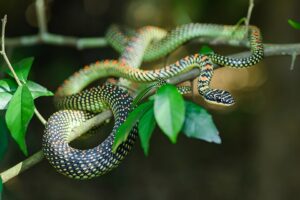
 The Draco lizards are joined by nearly a dozen different kinds of geckos that have also evolved gliding ability. Remarkably enough, there are even a few species of snakes living in the Indo-Malayan region that can glide.
In Malaysia, I found that there are also around a dozen squirrels that have gliding ability. An extravagance compared to the single species of flying squirrel I was familiar with back in Indiana. All told, I found the southeast Asian rainforests were home to dozens of different kinds of gliding animals representing three different vertebrate Classes – the Amphibia, the Reptilia, and the Mammalia. What an amazing assemblage!
After leaving Malaysia, I had the good fortune to visit tropical rainforests in Central and South America. I soon found myself questioning, “Where are all the rainforest gliders?” I saw none, nor did I hear mention of any from my incredibly knowledgeable guides. Why are there so many kinds of gliding animals in SE Asia but not here, I wondered? Seeking an answer to this question led me down a fascinating investigative trail.
As I further considered the fauna of places like Costa Rica, Panama, Ecuador, and Peru, I discovered that gliders essentially did not exist here. How did this compare with the tropical rainforest of equatorial Africa, I wondered? Turns out, there is a scarcity of gliders there too. Only a few species of flying squirrels have evolved this ability. Why would such a unique and useful method of locomotion evolve only in the tropical rainforests of Asia and nowhere else?
As you might guess, I wasn’t the first biologist to ponder this puzzling question. Others interested in this question began by asking whether the plant structure of the tropical rainforests of Asia, Africa, and South America might be different. Maybe some physical features of these forests could act to favor certain mutations or recombinations of animal genes. Such permutations of the genetic code could lead to the adaptive evolution of gliding behavior.
Useful modifications might include more extensive webbing of the toes, the ability to flatten the body into an airfoil, growth of excess skin along the sides which could function as patagia (airfoils of skin), or elongation of the ribs to support the skin of the patagia. Even the behavioral inclination to make broad leaps between trees would be adaptive.
Tropical rainforests of the world look surprisingly similar when flying above them. I have always thought they look like a vast, Brobdingnagian garden of broccoli heads lying far below. Stretching to the horizon one sees mile upon mile of rounded, puffy, green crowns of various hues. But this is misleading.
In reality, given the vast distances between them, we should guess that the tree species comprising the forests of Asia, Africa, and South America would be different. If so, maybe the physical structure of the forests would be different as well. Sure enough, when zoologists seeking answers to the evolution of gliding behavior examined the three forests closely, differences in their structure were observed.
Researchers detected a major distinction among these three tropical rainforest areas of the world regarding the distribution of lianas within them. Lianas are woody, vining plants rooted in the ground. They use trees as scaffolding to grow into the canopy. In this high tier of the forest, their leaves can receive more sunlight for photosynthesis.
In African rainforests, lianas grow densely near the ground and can make up over 40% of the plant life. This thick, tangled growth would make gliding difficult. But the lianas do make for an easy and efficient way to climb into and among the trees. Here gliding would not be that advantageous. It is more practical to just use the vines as stairways.
The rainforests of Central and South America—known as the Neotropics—are also full of lianas. These vines create natural pathways for climbing animals but also block the open space needed for gliding. As a result, climbing is the more favorable adaptation. Locals even call a commonly encountered liana “escalera de mono”—Spanish for “monkey ladder”. Perhaps this illuminates an intuitive understanding of the role lianas play in arboreal travel.
In contrast, Southeast Asian rainforests—like those in Borneo—have far fewer lianas. One study found they make up less than 15% of the woody plants. With fewer vines to climb and fewer obstacles in the air, gliding becomes a much more helpful way to travel between trees. In these forests, animals that glide may have a real advantage. Thus, the so-called selective pressure for the evolution of gliding would be high.
Another physical factor favoring the evolution of gliding was found during this research. The average height of the trees in SE Asia is significantly greater than in Africa or South America. The forests of Malaysia, for example, have many tree species that grow to heights of 165 to 200 feet. Some emergent trees may tower over 250 feet above the forest floor. In Amazonia and equatorial Africa, maximum heights of 150 feet or so are more common.
There is a simple, direct relationship between the height at which a glide is undertaken and the distance an animal can travel. The higher the launch, the greater the distance which can be covered. Perhaps being able to utilize higher “launch pads”, and thus make longer glides, is also a selective factor favoring the evolution of gliding in SE Asian forests. In rainforests with trees of less average height, gliding might not offer such a distinct advantage.
Perhaps the potential for long glides provided by the greater tree height in these forests, coupled with the paucity of lianas, act in concert to provide a powerful selective pressure in favor of gliding. This hypothesis may explain why only the rainforests of Asia have produced such a bewildering assemblage of gliding vertebrates while the forests of South America and Africa have not.
Attentiveness, curiosity, and the habit of asking questions can lead us down some truly fascinating paths. These are skills worth cultivating, as they often spark one discovery after another. You, dear reader, may have little interest in becoming a biologist—and that’s perfectly fine. But consider this: the living world offers endless opportunities for contemplation and wonder. Qualities like alertness, a sense of awe in the presence of earth’s seemingly infinite biodiversity, and the impulse to ask why or how can enrich the life of any nonscientist. Try them out on your next walk in the woods or moment beneath the sky. You may find your world growing a little larger, a lot more interesting, and perhaps even a touch more enchanting.
______________________________________________________________________
Photo Credits:

Draco with “wings” extended by the author

Kuhl’s flying gecko by Bernard DuPont @ commons.wikimedia.org

paradise tree snake by Rushed/Thai Natl. Parks @ commons.wikimedia.org

Interested in a deeper dive?
-
Emmons, Louise H. and A.H. Gentry. 1983. Tropical forest structure and the distribution of gliding and prehensile-tailed vertebrates. The American Naturalist. -
Forsyth, Adrian. 1990. Portraits of the Rainforest. Pp 66-67. Camden House. North York, Ontario.