As a boy, growing up in the 1950’s, my world was rich with science fiction movies depicting the horrors of nature gone wrong. The screens were filled with giant insects and massive arachnids. These were so large that an entire cow could provide little more than a snack. In other scenarios, even typically innocuous plants had gone rogue and relished nothing more than a nice meal of Homo sapiens.
From the classic The Thing from Another World (1951) which featured a sentient, humanoid vegetable, to the elephant-trapping flora of Tarzan’s Peril, carnivorous plants have long been a staple of science fiction. Could such kinds of plants really exist? As you may have guessed, they do indeed; but with a disclaimer.
Unless you happen to be the size of an insect, the plants I’m about to introduce should provoke no nightmares. Instead, they ought to spark a sense of wonder. For here is yet another group of living things—quietly flying under most people’s radar—that has evolved remarkable adaptations for the maintenance of life. Such adaptations enable these organisms to live in what might otherwise be rather inhospitable environments.
A good first question would be, why have carnivorous plants evolved mechanisms for capturing and digesting animals? After all, they are plants and plants are autotrophs. As we all learned in high school biology, autotrophs are organisms which can biochemically manufacture their own food.
In the case of plants, it is the process called photosynthesis that allows for energy production. Remember the equation you learned that showed carbon dioxide, water, and sunlight energy interacting to form glucose, a nearly universal cellular fuel? And carnivorous plants do have the photosynthetic factories we call leaves. They don’t need to eat anything. So, what’s going on?
Well, there’s a catch to this question of nutrition. Cells, and thus whole organisms, don’t live on fuel alone. They also need building‑block chemicals such as nitrogen, sulfur, and phosphorous to synthesize proteins, fats, and other essential compounds. And where do carnivorous plants get these chemicals?
I’m sure you’ve guessed the answer. They get these nutrients from the insects they prey upon. Carnivorous plants typically live upon soils which are poor in nitrogen, phosphorus, and potassium. Their amazing predatory adaptations have evolved specifically for thriving on soil which would otherwise be unhealthy for a plant.
The living world contains a variety of plants which consume animals, primarily in the form of insects. These include the Venus flytrap, sundews, bladderworts, butterworts, and pitcher plants. I find this last group especially fascinating and beautiful.
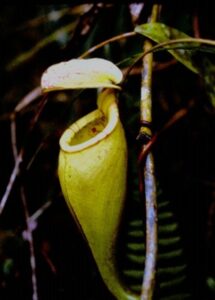
My first encounter with pitcher plants occurred many years ago in the highlands of Peninsular Malaysia. Even now, I clearly recall my excitement at finally seeing this legendary plant growing in its natural habitat. Back home in Indiana we do have a native pitcher plant, but in SE Asia the tropical forests exhibit their comparably astonishing biodiversity by hosting over seventy different species. There are over thirty different kinds just on the island of Borneo.
The pitchers of these plants are formed from modified leaves and vary in size. Nepenthes rajah, native to Borneo, has pitchers large enough to hold several cups of water. In others, there may be only a few spoonful’s of fluid. The fluid secreted by the plants into their pitchers is a rich stew of digestive chemicals including several types of digestive enzymes as well as antimicrobial compounds.
In addition, pitcher plants secrete nectar from the rim of their often brightly colored pitchers as well as from the lid. This lid also serves as a rain shield and often helps to guide prey into the pitcher. Attracted to the plant’s nectar, insects find themselves upon a slippery surface which results in a sliding fall into the digestive fluid waiting below.
This drama of evolutionary adaptation and predator-prey relationship between plant and insect is quite amazing. But, as we might expect in the tropical rainforest, such a relationship can be even more astonishingly nuanced. The degree of complexity and variety of interactions (niche specializations) among the species of these forests is overwhelming. Here are a couple of examples that fascinate me.
In Borneo, there is a species of mammal known as Hardwicke’s woolly bat. Bats, as we know, often roost in caves, under leaves or in leaf clusters of trees, or under tree bark. But this woolly bat uses the pitcher of a pitcher plant as a roosting site. Clinging inside the pitcher, just above the reservoir of fluid, the bat spends the day out of sight and secure. Research has revealed that the back wall of this plant’s pitcher has evolved a structure which more effectively reflects the woolly bat’s echolocation broadcasts. This makes it easier for the bats to locate their favored roosting site.
There is yet more to this relationship. While providing the bat with a safe hiding place, the pitcher plant receives a steady supply of bat droppings or guano. Bat guano is rich in nitrogen, precisely why it has been mined by humans as a source of fertilizer. So it is that both the bat and the pitcher plant derive benefit from their relationship. This is a classic example of a symbiotic relationship biologists refer to as mutualism.
The Rajah Brooke’s or Giant Malaysian pitcher plant (the aforementioned 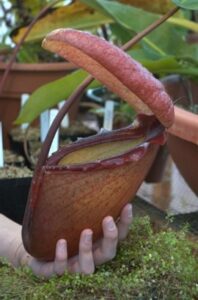 Nepenthes rajah) is the largest of its kind in the world. Its pitchers can grow to nearly a foot and a half in length and can hold two and a half quarts of liquid. This makes it a prime candidate for visitation by mammals even larger than a bat.
The mountain tree shrew of Borneo is such a visitor, and is an animal interesting in its own right. Tree shrews look much like squirrels. But they are actually more closely related to primates, and do have the large brain to body mass ratio typical of these mammals. They are not true shrews, nor do they spend all their time in trees.
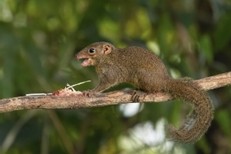 Mountain treeshrews (common treeshrew shown here) are about ten to twelve inches in total length. They can safely perch on the rim of the giant pitcher plant while licking the abundant nectar from the underside of the plant’s lid. While doing so, the tree shrew’s rear hangs above the pitcher opening. Into the pitcher it may then deposit its droppings. So, in exchange for the meal, the tree shrew leaves a little nutrient packet for the plant containing nitrogen, phosphorus, and potassium. Like Hardwicke’s woolly bat, another fine example of mutualism.
My hope is that this brief foray into the world of pitcher plants has allowed you a glimpse into the truly rich, fascinating, and beautiful natural world of which we are all a part. As ever, I encourage you to explore, read, look, and learn more. Always keeping in mind, the words of the great British naturalist Alfred Russel Wallace: Can we believe we are fulfilling the purpose of our existence while so many of the wonders and beauties of creation remain unnoticed around us?
_____________________________________________________________________________
- For a nostalgic trip back to the era of my boyhood, and a look at how drastically cinematic special effects have progressed, check out these YouTube trailers. You’ll see what I mean.
The Woman Eater. 1958 (https://www.youtube.com/watch?v=PT0CRZEANKA)
Voodoo Island. 1957 (https://www.youtube.com/watch?v=BEdlSI2mYps)
The Land Unknown. 1957. (https://www.youtube.com/watch?v=ltNMWNjB8GE)
2. You can find video of the giant pitcher plant and the tree shrew/pitcher plant interaction on YouTube by searching for “David Attenborough pitcher plants and/or tree shrew.”
- Photo Credits
Nepenthes sp. by the author
Nepenthes rajah Jeremiahscps at commons.wikimedia.org
common tree shrew Isha Mukherjee at commons.wikimedia.org